


Champakulam Boat Race
Champakulam Boat Race
The first in the season of snake-boat races (Vallam Kali) in the State, the Champakulam “Moolam” Boat Race is a tradition that is more than 500 years old and is held on the Pampa river at Champakkulam. The race is organized by the Champakulam boat race society and headed by the district collector. Different categories of boats are used in this race. Some of the most well known categories are the chundan (snake boat), which is the most decorated and attention grabbing. The veppu, iruttu kuthi, churulan and Odi are a few others.
Legend has it that during 1545 A.D., Maharaja Devanarayana of Chempakasseri built a temple for Lord Krishna at Ambalapuzha as per the suggestions of his astrologers. But at the last moment, the deity meant for the temple was found to be inauspicious. The priests therefore identified another idol of Lord Krishna at the Karinkulam temple at Kurichi. This idol was believed to have been given to Arjuna by Lord Krishna himself. On the way back from Kurichi, night had set in and the King’s men stayed at a Christian household in Champakulam. This was the home of Mappilassery Itty Thommen, a loyal subject and a confidant of the king. The next day, the king along with his entourage came to Champakulam and respectfully took the idol in a flotilla to the Ambalapuzha temple.
Pleased with the love and affection shown by the Christian subjects and to commemorate the event and to strengthen the ties of the Hindu-Christian community, the King declared that henceforth a water festival would be held annually at Champakulam and thus began the Champakulam Snake Boat Race which continues even today.
On the day of the race, both the locals and visitors from far off places, flock to the river bank to enjoy the scenes of the race. This race is often considered as the ultimate test of endurance, speed and skill. As the oarsmen set the pace of their boats with oars striking the placid water, the river becomes a track on fire and becomes a real feast for the eyes and minds of the spectators.

Ayurveda
Ayurveda
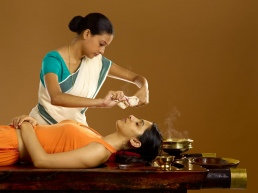
Ayur means life and veda means science, hence Ayurveda, the science of life, refers to the traditional medical and healthcare practice in India. The origin of Ayurveda, then a tradition that was passed down orally, dates back to around 5,000 BC. Considered to have its major roots and inspiration from the Atharvaveda, Ayurveda, emphasizes on the humoral balance of three elemental substances or doshas in the human body: Vata, Pitta and Kapha. While doshas that are balanced result in good health, their imbalance results in diseases and ailments. Ayurveda does not just focus on the physical health but also on the holistic wellness of a human being which includes their mental and spiritual health. It has laid down instructions on various diagnosis techniques, drugs and treatments for illnesses and equally on how to lead a healthy life through the practice of yoga, a proper diet etc.
The word Ayurveda is synonymous with the state of Kerala, which has an unbroken relationship with it for the last hundred years despite various hurdles of invasions. Apart from the large availability of trained Vaidyars, to whom the knowledge of Ayurveda has been passed down through generations, it is the blessed landscape of Kerala with its forests and mountains and ideal climate that has made the State a paradise for Ayurveda. In terms of climate, it is perfect for both guests and herbs. For the guest, the weather, especially from June to September, which remains cool and relatively even during the day and night, stresses the body very little, while the moist and dust-free air due to the rain, helps to open up the body’s pores quickly, making it receptive to herbal oils and therapy for an optimal result. The climate of Kerala is also conducive for herbs to grow on their own, throughout the year.
While the primary concern of Ayurveda practice is the prevention of ailments, the curing of ailments is a secondary importance. For curing treatments, the elimination of toxic elements from the body is the primary function, since the removal of toxic elements purifies the body. It rejuvenates the mind, body and soul and makes the body more effective. Once the purification is done, the actual treatment of the ailment is carried out through various therapies like massages, kashayams, diet-control, yoga, meditation or exercise depending on what the person suffers from.
Kerala has a number of Ayurveda treatment centres which offer various packages, from treatments like Abhyangam , Nasyam , Snehapanam , Kizhi, uzhichil , pizhichil, Njavarakizhi, Sirodhara, Vasthi, Sirovasthi, Udvarthanam etc. to the teaching of Yoga and diet control practices. So why wait…escape from the mundane, hectic, everyday existence to find the healthier side of you with us.

Ramzan (Eid al-Fitr)
Ramzan (Eid al-Fitr)
The festival of Ramzan is not a one day celebration. The eve of Ramzan marks the end of a month long dawn-to-dusk fasting (the month of Ramzan) by the Muslims that is marked with alot of excitement and rejoicing like the love of visiting relatives, neighbours, friends, the wearing of new clothes, gift giving, sharing sweets and special meals prepared for the day. During the holy month of Ramzan, they abstain from all worldly pleasures, hence the observance is primarily about being more pious and seeking spiritual closeness to God, self-control and discipline.
Ramzan is the ninth month in the Muslim Hijri calendar and is known as the holy month. Legend has it that the great spiritualist Mohammed was blessed by the Angel Gabriel through the divine knowledge of the Quran during this month. According to hadith, all of the Holy Scriptures were also sent down during Ramzan. Hence in order to pay tribute to the efforts of Prophet Mohammed, the month long fasting is observed.
Right from day one, Muslims wake up before sunrise, bathe and then eat something called “suhoor,” a pre-dawn meal which has foods like dates and milk to help them survive the day without food. During the day, they offer prayer five times, while at dusk, they break their fast with a large sumptuous feast known as “iftar”. It includes an array of different fruits, fries and other delicacies which are shared amongst the members of the family.
Despite the fact that Muslims are spread all over the country, places like the Jama Masjid in New Delhi, the Aishbagh Idgah in Lucknow, the Mecca Masjid in Hyderabad and a few mosques in Kerala are the main hubs to witness the true spirit of Ramzan. The festivities give you an opportunity to savor the local delights such as the sewai in New Delhi, the mouth-watering nihari qulche and kebabs at Lucknow, the Hyderabadi Haleem in Hyderabad and the nombu kanji in Kerala.

Puri Jagannath Yatra
Puri Jagannath Yatra
Do you know the etymology of the word “juggernaut”? The word originated from Jagannath and means “overwhelming force”. It literally derives its meaning from the visual picture of the huge rath yatra of the Jagannath temple. The prime attraction of the festival are the elaborate chariots from time immemorial. There are three main chariots, each of different color, size, and height. The Nandighosa, Lord Jagannath’s Chariot has 18 wheels and is decorated with yellow and red fabric and has a height of 45.6 feet. The Taladhvaja, Lord Balabhadra’s Chariot has 16 wheels and is decorated with green and red fabric and has a height of 45 feet. The Devadalana, Goddess Subahdra’s chariot, has 14 wheels and is decorated with black and red fabric. It has a height of 44.6 feet. Each chariot is pulled by hand with the help of a 50 meter rope.
Legend has it that this Rath Yatra refers to the occasion when the mighty Lord Jagannath along with his elder brother Lord Balabhadra and his sister Goddess Subhadra travelled to visit and sojourn at his aunt’s place at the Gundicha Temple for 9 days. Their return home is the occasion called the Bahuda Jatra. Spiritually the rath is compared to the “body”, the distance covered refers to the path taken by the body to reach its destination “moksha”, and the journey itself is known as Ratha Yatra.
Every year, the rituals start at least one month prior to the festival day, right from the construction of new chariots and the bathing of the idols called Snana Pornima. The healing of illnesses called the Ansara-ritual is held a fortnight before the festival. Another interesting ritual is called the Chhera Pahara where the King of Puri sweeps the floor of the chariots with a broom. He then cleans the streets and sprinkles sandalwood water before the procession of the chariots. This ritual signifies that even the highest power of the country is only a servant before God.
After 9 days, the Bahuda Jatra takes place. This is the deities’ journey back to the Shri Mandir which is celebrated by the people of Odisha with offerings of Poda Pitha, a kind of baked cake that is later consumed by the devotees.

San Jao
San Jao
If you want to watch a most pompously celebrated religious occasion in Goa, then the Sao Joao Festival celebrated by the Catholic community dedicated to St. John the Baptist is a must see. Though a religious celebration, this fete is more of a youngsters’ festival celebrated by newlywed couples and the unmarried. They wear Kopels (floral crowns) on their heads, dance to the beat of drums, march to a nearby water body and then jump into it shouting ‘Viva San Joao’. The end of the festival is marked by a lavish feast of meat and seafood along with live music performances.
The festival is celebrated to commemorate the leap of joy experienced by St. John while he was in the womb of his mother Elizabeth when Mother Mary came to inform her that she was pregnant. Hence the custom of people jumping into a water body is considered to be the leap of joy felt by St. John and the water body itself is considered to be reminiscent of the womb of Elizabeth.
This festival is celebrated with high spirit in the north of Goa, especially in Siolim, Anjuna, Calanguate and Assagao. Along with Kopel and the jumping into water, colorfully decorated floats, the Sangodds, made by joining boats using banana trunks covered with coconut palms, forms another important attraction of the celebration.

Ganga Dashahara
Ganga Dashahara
The river Ganges is seen as a form of goddess Ganga Mata or Ganga Devi or Ganga Maiya and is legally a living entity. It is considered as one of the holiest rivers from time immemorial. Right from the Vedas, the Puranas, the Ramayan, the Mahabharatha and in most of the epics related to Hinduism and India, the Ganges has a special mention. Legend has it that king Bhagiratha, through sheer hard penance, brought down this Holy River to Earth from Heaven, to wash away the sins of his 60,000 ancestors who were killed due to a curse from sage Kapila for disturbing his meditation. From then on, it is believed that Gangajal or the water of the Ganges cleanses all sins, and he who takes a dip, touches or even looks upon this holy river, receives heavenly blessings.
Ganga Dashahara is the day when king Bhagiratha brought down the Ganges to Earth. The literal meaning being Dasha = Ten and Hara = to destroy, which means a soak in the Ganges on this auspicious day will eliminate ten lifetimes worth of sins. The celebration starts ten days prior to the eve of Ganga Dashahara.
On the day of the festival, devotees take a dip in the holy river early in the morning and take back home some clay and holy water for pooja. The priests perform aartis to goddess Ganga amidst hundreds and thousands of pilgrims throughout the day. In the evening, devotees offer leaf boats with flames, sweet and flowers to the river. Big fairs are also organized at the celebration venue during this day.
So why wait, get yourself drenched in the spiritual rain of beautiful shlokas, bhajans, kirtans, bell sounds and aartis praising the goddess Ganga at the major ghats of Varanasi, Allahabad, Garh-Mukteshwar, Prayag, Haridwar and Rishikesh.